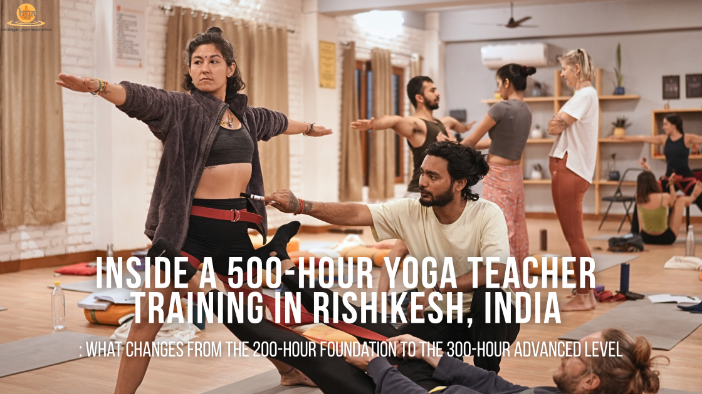
A 500-hour yoga teacher training pathway is commonly built from two stages: a 200-hour foundational training followed by a 300-hour advanced training. The difference is not simply that the second stage includes harder postures. The larger shift is from learning core teaching skills to applying them with greater judgment, observation and adaptability.
This guide compares the two stages across asana, anatomy, philosophy, sequencing and teaching methodology, and also explains how 200-hour and 300-hour training relate to Yoga Alliance’s RYT 500 hour yoga teacher training course rishikesh credential.
200-Hour vs 300-Hour YTT: The Short Answer
200-hour training is generally the foundational teacher-training stage. It focuses on core yoga practices, basic anatomy, teaching methodology, sequencing and supervised teaching practice.
300-hour training is advanced training designed for students who have already completed a 200-hour foundation. It usually develops deeper teaching judgment, functional application, advanced methodology and more independent teaching practice.
For Yoga Alliance registration, a 500-hour pathway may be completed through a single RYS 500 program or through an RYS 200 plus an RYS 300.


How Does a 500-Hour Yoga Teacher Training Actually Work?
Usually a 500 hour yoga teacher training course is done over two periods. First comes the 200-hour yoga teacher training foundation. Next is the advanced training of 300 hours. These two stages make up the 500-hour YTT pathway.
Stage 1 – 200-Hour Foundation
The 200-hour level builds the base. It teaches the fundamental skills that all yoga teachers should know. Typically consists of:
- Hatha and Vinyasa yoga
- Ashtanga Vinyasa practice
- Basic alignment principles
- Pranayama – breath control
- Meditation techniques
- 7 cleansing methods (Shatkarma)
- Yoga philosophy
- Anatomy and physiology
- Teaching methodology
- Basic sequencing
- Practice teaching sessions
This is the stage where you will get to know the alphabet of yoga. Students learn the purpose of each pose, proper breathing and how to lead a simple class safely.
Stage 2 – 300-Hour Advanced Training
The 300 hour advanced yoga teacher training is built upon that foundation. It does not repeat the basics. Rather, it delves into the details of each subject. The stage usually involves:
- Advanced asana understanding
- Advanced alignment techniques
- Hands-on adjustments
- Advanced teaching methodology
- Yoga therapy principles
- Ayurvedic and yogic lifestyle.
- Deeper anatomy study
- Advanced sequencing
- Advanced philosophy
- More independent teaching practice
Therefore, the 200-hour stage will ask “what” and “how” questions, whereas the 300-hour stage will ask “why” questions. It’s here that an effective teacher is truly effective.
200-Hour vs 300-Hour: A Quick Comparison
| Area | 200-Hour Foundation | 300-Hour Advanced |
|---|---|---|
| Asana | Core technique, alignment and safe execution | Refinement, modification and teaching application |
| Anatomy | Foundational anatomy and movement concepts | Deeper functional application and teaching decisions |
| Philosophy | Core yogic concepts and texts | More detailed interpretation and integration |
| Sequencing | Foundational class structure | More adaptive and purposeful sequencing |
| Teaching | Guided practice teaching | Greater independence and responsiveness |
| Pranayama | Foundational techniques | Deeper application and integration |
| Ayurveda | Depends on the school curriculum | May be studied in greater depth where included |
| Teacher development | Building core confidence | Developing judgment and adaptability |
How Asana Practice Changes from Foundation to Advanced Training
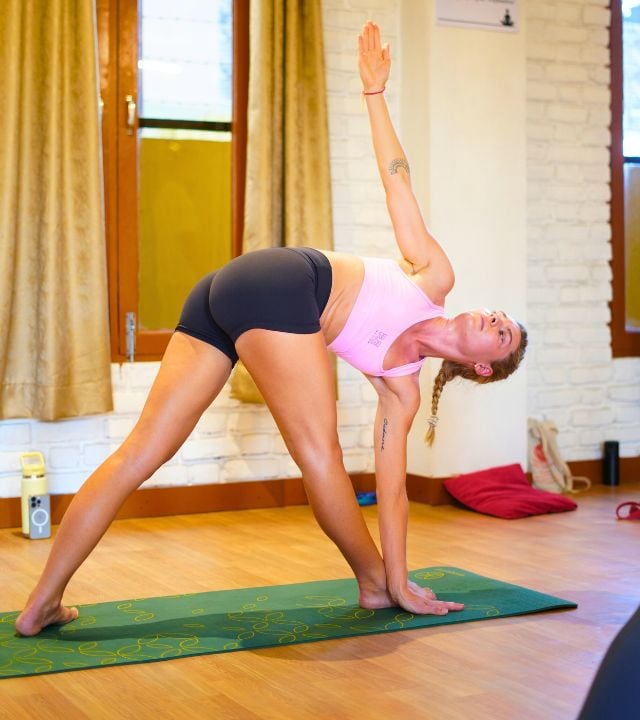
Let’s get one thing straight. Advanced yoga does not mean harder poses. It is an understanding of the poses a student already knows, but in a deeper way.
The 200-hour level has a straightforward progression of asana: Foundation, Stability, Alignment, Breath Coordination and then Safe Execution. In this exercise, we are aiming to create a body that moves with safety and a mind that is here.
The method shifts after 300 hours. It changes to Observation, then Refinement, then Modification, then Progression, then Contraindications, then Sequencing and finally Teaching Application. Practising poses is not what students are just doing anymore. They are learning to view poses from a teacher’s perspective.
This stage is more advanced and includes the following areas of importance:
- Postures preparatory that lead up to a peak posture
- Peak pose progressions and safe ways to build up to these poses.
- Safe ways to deal with inversions.
- Progressions with backbends, step by step.
- Arm balances and the power they take to build them up.
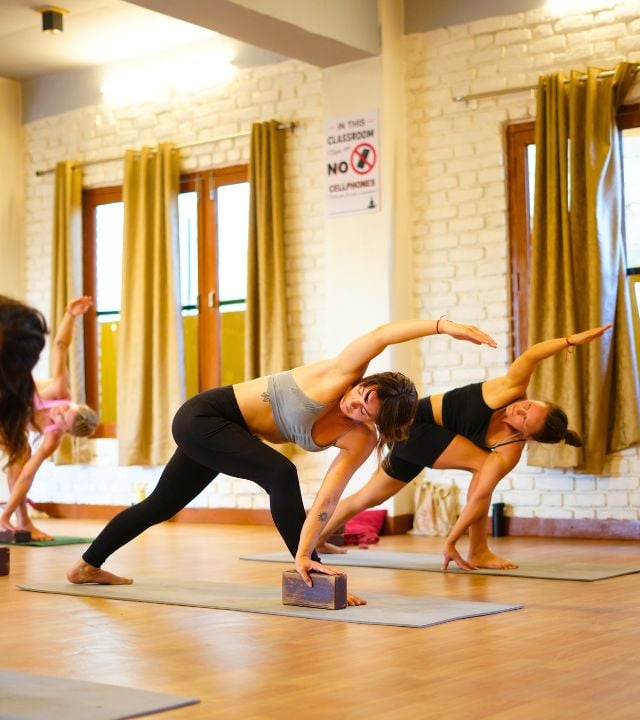
- The use of props to support different bodies
- Provided modifications in response to different needs and abilities.
- Student-to-student variations in the body
- When a pose should not be used (contraindications)
- Accepting student alignment from the outside
- Tuning for various figures and shapes
The 200-hour stage is designed to build a reliable foundation in practice and teaching. The advanced stage places more emphasis on observing students, adapting instructions and choosing appropriate variations. A 300-hour graduate can walk into a room of kids and see what they need, what props they need, or what other variations they need. That’s one of the greatest changes in the 500-hour yoga teacher training period – from doing to observing.
From Anatomy to Application: Yoga Therapy, Ayurveda & Safer Teaching
The 200 hour level of anatomy is largely theoretical. Students are taught the names of muscles, bones and joints. It is helpful, but still a bit of an abstract concept at this point.
In the advanced training of 300 hours, anatomy is made practical. A competent teacher should be able to answer questions such as these during an observation of a student practising:
- What is actually happening in this student’s body right now?
- Should this posture be modified for them?
- What is the better alternative to the movement here?
- Are there any precautions to consider?
- When can a hands-on adjustment be completely avoided?
Students study functional anatomy in more depth to be able to answer these questions confidently. It involves the movement of the joints, spine, shoulders, hips and knees. They also are exposed to the most common physical restrictions and the early signs of possible injury.
By this time, contraindications and modifications are ingrained in your normal practice. Pupils are also introduced to basic principles of yoga therapy, which is the use of yoga to encourage general well being and more conducive movement patterns. To be clear, yoga therapy, as practiced here, is not alternative medicine, but a complementary medicine. It just assists a teacher to guide his students more thoughtfully and responsibly.
At this stage ayurveda is also introduced. Students are introduced to the ancient system’s understanding of body types, how they operate through the day and how their lifestyle can affect them. Together, yoga therapy and Ayurveda complete a teacher’s knowledge of the student, beyond the body, beyond yoga.
How Teaching Methodology Evolves During 500 Hours
Teaching is a skill and, like any skill, it is acquired over time. The difference between a 200 hour trainee and a 300 hour trainee is most noticeable here.
In the initial phase the process is straightforward: learnt, practised, and demonstrated. Students are eager to get to a class and to remember the basics of a sequence.
As training continues it turns into: Demonstrate, then Cue, then Observe, then Correct. It is during this training that trainees start focusing on their students, not on themselves.
By the advanced stage, teaching development looks like this: Observe, then Modify, then Sequence, then Adapt, and finally Teach Independently. This is when the trainees break out of the script and begin making decisions on the spot in the room.
In all these phases, students develop broad-based hands-on abilities such as:
- Clear and effective verbal cueing:
- Excellent demonstration of poses with confidence
- Precise alignment instructions
- Excellent timing of class work.
- Careful transition and progression throughout the work.
- Relaxed movements between poses.
- Helpful adaptations for various students
- Sharp observation skills
- In an effective way using props
- Teaching mixed-level classes
- Teaching complete beginners
- Supporting students of varying levels of competence
- Giving and receiving student feedback
- Creating a natural and confident teaching voice.
- Creating complete, well-structured classes
- Utilizing feedback from lead teachers
The important point to remember is that the 200 hours is for the foundations of teaching and 300 hours is to understand when, why and how to adapt those foundations. Advanced yoga teacher training is all about this transition from being formulaic to making decisions.
500-Hour Certificate vs RYT 500
This is one of the most often misunderstood items and it needs to be explained in a clear and concise manner.
The training certificate that a student receives upon successfully completing the 500 hours of yoga teacher training is a 500-hour YTT certificate. It just indicates that the training itself is finished. It indicates that the student has completed the 200-hour foundation and 300-hour advanced course and has satisfied all the requirements of the course.
RYT 500, on the other hand, works differently. It is a YA teacher registration not a certificate. It is more than just completion of a training program; this has its own eligibility requirements. One could finish a full 500 hour YTT, but still be required to take one more step to register as a RYT 500 with Yoga Alliance.
So there is a relationship between the two, but not the same. The first milestone is to finish the 500 hours of training. The second milestone, and a different one, is that of gaining acceptance as a RYT 500. Once students are aware of this difference then they are able to set their right expectations before enrolling and avoid any confusion later in the teaching process.
There are a few frequently asked questions about this subject:
What is RYT 500?
RYT 500 is a Yoga Alliance teacher-registration credential for teachers who meet the required training and teaching-experience criteria. It is not simply the name of a 500-hour course.
How do I become RYT 500?
Complete either an eligible 500-hour RYS program or an eligible RYS 200 + RYS 300 pathway, then meet Yoga Alliance’s teaching-experience and registration requirements.
Does 200 + 300 equal 500 for Yoga Alliance?
Yes, provided the 200-hour training is with an active RYS 200 and the 300-hour training is with an active RYS 300. They may be completed at the same or different registered schools.
Is a 500-hour YTT the same as RYT 500? Not exactly. The first step is to complete the training. Yoga Alliance registration is an extra step.
Is teaching experience required?
Yes. Yoga Alliance currently requires at least 100 teaching hours after completion of RYS 200 or RYS 500 training.
A 500-hour YTT certificate and the Yoga Alliance RYT 500 credential are related, but they are not the same thing.
A 500-hour YTT certificate documents successful completion of a qualifying 500-hour teacher-training pathway.
RYT 500 is a Yoga Alliance teacher registration. Under Yoga Alliance’s current standards, applicants can qualify through either a single 500-hour program with an RYS 500 or by combining a 200-hour program with an RYS 200 and a 300-hour program with an RYS 300. Applicants must also complete at least 100 hours of teaching experience after completing RYS 200 or RYS 500 training before obtaining the RYT 500 credential.
Does 200 + 300 hours make a 500 hour training pathway? Yes. The 200 hour foundation and 300 hour advanced training can be completed as a single recognised 500 hour training pathway.
Bringing It All Together
A 500 hour Yoga Teacher Training is not simply an extended 200 hour yoga teacher training program. It is an all the way trip. From teaching the fundamentals of asana, alignment and teaching, students build real judgment, more in-depth anatomy and independent teaching confidence.
The 200 hour foundation lays the foundation. The 300-hour advanced training develops the wisdom for its proper use. They jointly create the type of teacher who can confidently enter any room.
If you are thinking of this career path, you can find more details about the full course, schedule, and requirements on the 500 Hour Yoga Teacher Training in Rishikesh page on Himalayan Yoga Association.
Frequently Asked Questions
What is the difference between 200-hour and 300-hour yoga teacher training?
A 200-hour yoga teacher training builds the foundation in asana, alignment, pranayama, meditation, anatomy, philosophy, sequencing and teaching methodology. A 300-hour training is an advanced stage designed to deepen those skills through more detailed anatomy, sequencing, observation, modifications, philosophy and independent teaching practice.
1. Do I need a 200-hour certificate before taking 300-hour training?
Yes, in the standard Yoga Alliance pathway, 300-hour advanced training is intended for students who have already completed a 200-hour teacher training. Students should always confirm the entry requirements of the specific school before enrolling.
2. Does 200 + 300 hours qualify as a 500-hour pathway?
Yes. A 200-hour foundational training followed by a 300-hour advanced training can form a 500-hour yoga teacher training pathway. For Yoga Alliance purposes, the programs must meet the applicable Registered Yoga School requirements.
3. What is the difference between a 500-hour YTT certificate and RYT 500?
A 500-hour YTT certificate confirms that a student has completed the required training. RYT 500 is a separate Yoga Alliance teacher-registration credential. Completing the training is therefore one step; applying for and meeting Yoga Alliance’s RYT 500 requirements is another.
4. How many teaching hours are required for RYT 500?
Yoga Alliance currently requires at least 100 hours of teaching experience after completing an eligible RYS 200 or RYS 500 training before a teacher can register as RYT 500.
5. Is the 300-hour course more physically advanced?
Not necessarily. Advanced training does not simply mean harder postures. The main progression is toward deeper understanding, safer modifications, observation, sequencing, anatomy, teaching judgment and the ability to adapt classes for different students.
6. Can the 200-hour and 300-hour courses be completed at different Yoga Alliance schools?
Yes. Under Yoga Alliance’s current pathway, the 200-hour and 300-hour programs may be completed at different eligible Registered Yoga Schools, provided the training meets the relevant RYS 200 and RYS 300 requirements.