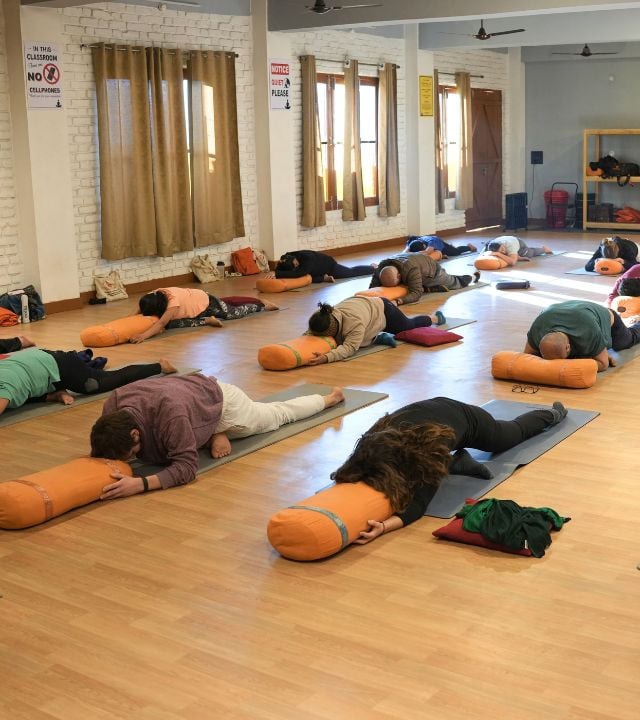
There are moments during deep relaxation when the body feels completely still, the breath becomes subtle, and yet a part of you remains aware.
This is the territory explored through Yoga Nidra.
Yoga Nidra, also commonly searched for as Yog Nidra, is traditionally translated as “yogic sleep.” Despite the name, the purpose is not simply to fall asleep. The practitioner lies comfortably, usually in Shavasana, and follows a systematic journey of awareness through the body, breath, sensations and mind while attempting to remain conscious.
It is one of yoga’s most accessible practices because it does not require flexibility, complicated postures or physical strength. A beginner can experience Yoga Nidra, while an experienced practitioner can continue discovering deeper layers of the practice over many years.
Yoga Nidra is often associated with deep relaxation, but its traditional purpose goes beyond ordinary rest. It is a practice of Pratyahara—turning awareness inward while reducing engagement with external sensory experience.


In modern yoga, the systematic form of Yoga Nidra became especially well known through the teachings of Swami Satyananda Saraswati and the Bihar School of Yoga. Bihar Yoga describes the method as having been developed from the tantric practice of nyasa into a structured system of physical, mental and emotional relaxation.
What Does Yoga Nidra Mean?
The term comes from two Sanskrit words:
Yoga – commonly understood as union, integration or a state of focused awareness.
Nidra – sleep.
Yoga Nidra is therefore commonly translated as yogic sleep.
However, this translation can be misleading if it makes us think Yoga Nidra is simply another form of sleeping.
During normal sleep we ordinarily lose conscious awareness of our immediate surroundings. During Yoga Nidra, the intention is to allow the body to become deeply restful while maintaining a thread of awareness.
A contemporary clinical review describes Yoga Nidra as a practice combining guided mental processes with Shavasana, creating profound relaxation while some awareness of the environment remains.
A useful way of understanding it is:
| State | What generally happens |
|---|---|
| Waking | Awareness is primarily engaged with the body, thoughts, senses and external world |
| Yoga Nidra | Physical activity decreases while awareness is progressively directed inward |
| Ordinary sleep | Conscious engagement with the external environment largely disappears |
| Meditation | Awareness is intentionally trained through a meditative object, process or state |
These distinctions are not absolute scientific categories. They are practical ways of understanding different experiences described within yogic practice.
Is Yoga Nidra the Same as Shavasana?
No. Yoga Nidra and Shavasana are related, but they are not the same practice.
This distinction is important.
Shavasana
Shavasana, or Corpse Pose, is an asana in which the practitioner lies on the back with the body supported and relaxed.
It may be practised:
- after an asana class
- as a relaxation posture
- before pranayama
- during meditation
- as the physical position for Yoga Nidra
Yoga Nidra
Yoga Nidra is a systematic inward-awareness practice that is commonly performed while lying in Shavasana.
Therefore:
Shavasana is usually the position. Yoga Nidra is the practice.
Someone can lie in Shavasana without practising Yoga Nidra.
Likewise, although Shavasana is the most common position, a practitioner who cannot comfortably lie flat may sometimes use appropriate support or another resting position.
The Indian Ministry of AYUSH also treats Yoga Nidra and Shavasana as related but distinct relaxation practices, rather than using the two names interchangeably.
This should replace every instance in your old article where you write “Yoga Nidra (Shavasana)”.
Yoga Nidra vs Meditation: What Is the Difference?
Yoga Nidra is frequently described as a meditative practice, but it is not identical to every form of meditation.
In many meditation techniques, practitioners sit upright and deliberately observe the breath, mantra, sensation, thought or another object of concentration.
In Yoga Nidra, the body normally rests in a reclining position and the practitioner follows a sequence of instructions that progressively draws awareness inward.
A typical Yoga Nidra session may involve:
settling the body → intention or Sankalpa → rotation of awareness → breath awareness → sensations → observation or visualization → silence → Sankalpa → gradual return
Meditation traditions differ greatly, so it would be inaccurate to say that all meditation produces one particular state of consciousness.
A better distinction is:
Meditation trains awareness through many possible methods. Yoga Nidra is a particular systematic method of guided inward awareness and deep relaxation.
The Traditional Idea Behind Yoga Nidra
Yoga Nidra becomes easier to understand when it is viewed through the yogic concept of Pratyahara.
Patanjali traditionally places Pratyahara as the fifth limb of Ashtanga Yoga, following:
- Yama
- Niyama
- Asana
- Pranayama
- Pratyahara
- Dharana
- Dhyana
- Samadhi
Pratyahara is commonly understood as a withdrawal or inward gathering of the senses.
You do not have to forcibly block sounds during Yoga Nidra.
You might still hear a bird, a door closing or activity outside.
Instead of following every sound mentally, you learn to recognise it without becoming completely involved in it.
This is one reason Yoga Nidra is different from simply lying down and trying to relax.
The Role of Sankalpa in Yoga Nidra
One of the characteristic elements of several traditional Yoga Nidra systems is Sankalpa.
Sankalpa can be understood as a conscious resolve or heartfelt intention.
It is not intended to become a long list of wishes.
Traditionally, the practitioner chooses a short, clear and meaningful statement and mentally repeats it during the practice.
Examples might be:
“I remain calm and aware.”
“I meet life with clarity.”
“I am committed to my practice.”
A Sankalpa is personal. There is no universal sentence that everyone needs to use.
More importantly, Yoga Nidra should not become a session of constantly thinking about goals. The resolve is introduced briefly and then the practitioner returns to the systematic practice.
What Happens During Yoga Nidra?
Although Yoga Nidra traditions differ, a complete practice often moves through several recognizable stages.
1. Preparation
The practitioner lies comfortably and allows the body to settle.
The intention is not to immediately force relaxation.
Instead, give the body enough time to become physically still.
2. Awareness of the Environment
Become aware of the room.
Notice distant and nearby sounds without trying to identify or judge every one.
This can help attention gradually move from the external environment toward the inner experience.
3. Sankalpa
A short personal resolve may be mentally repeated.
4. Rotation of Awareness
Attention moves systematically through different parts of the body.
Rather than physically moving each part, you simply become aware of it.
5. Breath Awareness
Attention is brought toward natural breathing.
There should normally be no need to force, retain or deliberately manipulate the breath during this stage.
6. Awareness of Sensations
Some Yoga Nidra traditions introduce contrasting experiences or sensations as part of the practice.
7. Visualization or Inner Observation
Depending on the tradition and level of practice, imagery, symbols or simple observation may be introduced.
8. Silence and Stillness
After systematic instructions, periods of quiet can allow the practitioner to rest in awareness without constantly doing something.
9. Repetition of Sankalpa
The original resolve may be repeated.
10. Externalization
Awareness gradually returns to the breath, body, room and surrounding sounds before movement resumes.
Returning gradually matters.
Do not suddenly jump up after a deep Yoga Nidra practice.
How to Practice Yoga Nidra: Step-by-Step Beginner Practice
The following is a simple practice for someone who is new to Yoga Nidra.
It is deliberately uncomplicated.
Step 1: Prepare Your Space
Choose somewhere quiet where you are unlikely to be disturbed for around 15–30 minutes.
Lie on a yoga mat, carpet or another stable surface.
If necessary, use:
- a light blanket
- a small cushion under the head
- support beneath the knees
- an eye covering if the environment is bright
The old belief that nothing should ever be placed underneath the body is unnecessarily strict.
Comfort matters because physical discomfort continually pulls attention away from the practice.
If you have a condition that makes lying flat uncomfortable, modify the position appropriately.
Step 2: Enter Shavasana
Lie on your back.
Allow the legs to rest comfortably apart.
Keep the arms slightly away from the torso.
Let the palms face upward or rest in whatever neutral position feels natural.
Close your eyes gently.
Take a few moments to notice where your body meets the floor.
Do not try to make anything happen.
Step 3: Become Aware of Your Natural Breath
Notice the breath as it enters and leaves.
Do not deliberately make it deeper.
Notice:
the movement of the abdomen,
the movement of the chest,
the temperature of the breath near the nostrils,
and the natural pauses between breaths.
The breath is not something you need to perfect.
Simply observe.
Step 4: Make Your Sankalpa
Bring your chosen resolve into your awareness.
Repeat it mentally with clarity.
Keep it short.
Then allow it to go.
Step 5: Rotate Awareness Through the Body
Begin with the right side.
Bring your attention to:
right thumb
index finger
middle finger
ring finger
little finger
palm
back of the hand
wrist
forearm
elbow
upper arm
shoulder
Continue through the right side of the body.
Then move systematically through the left side.
Become aware of the back of the body.
Then the front.
Then:
neck
jaw
mouth
nose
eyes
eyebrows
forehead
scalp
whole head
Finally become aware of the whole body resting together.
The objective is awareness, not muscular movement.
If thoughts appear, acknowledge that they appeared and continue with the sequence.
Step 6: Return to the Breath
Feel the breathing again.
Notice each inhalation.
Notice each exhalation.
You can follow a number of breaths backward if it helps maintain awareness:
27…
26…
25…
Continue without forcing your concentration.
If you lose count, simply begin again.
Step 7: Rest in Awareness
Allow the instructions to become fewer.
There may be sounds around you.
There may be thoughts.
There may be sensations.
You do not need to chase or suppress them.
Remain still and notice.
Step 8: Repeat Your Sankalpa
Recall the same resolve you used near the beginning.
Repeat it mentally.
Step 9: Return Gradually
Become aware of your natural breathing.
Feel the weight of your body.
Become aware of the floor.
Notice sounds in the room.
Notice sounds outside the room.
Gently move the fingers.
Move the toes.
Stretch only if the body wants to stretch.
When ready, roll to one side and gradually sit up.
Allow your eyes to open.
Remain still for a moment before continuing your day.
Om Shanti, Shanti, Shanti.
How Long Should Yoga Nidra Be?
There is no single correct duration.
A beginner might start with:
10–15 minutes for learning the basic process.
A regular session may last:
20–30 minutes.
Longer guided practices may extend to:
30–45 minutes or more.
A government yoga guideline from India’s Ministry of AYUSH includes Yoga Nidra sessions of approximately 20–30 minutes within its yoga-based lifestyle guidance.
Duration is less important than practicing attentively and consistently.
What Is the Best Time to Practice Yoga Nidra?
Yoga Nidra can be practised at different times depending on your purpose and routine.
Morning
A short practice can create a quieter transition into the day.
Afternoon
Yoga Nidra may provide a period of deliberate rest without necessarily taking a daytime nap.
After Asana Practice
This is particularly natural because the physical body has already moved and may be prepared for stillness.
Evening
A gentle Yoga Nidra practice can help create a transition away from the activity of the day.
Before Bed
Many people practise Yoga Nidra before sleep.
That is completely reasonable, but there is an interesting distinction:
If your intention is traditional Yoga Nidra practice, try to remain aware. If your only intention is sleep, it is perfectly fine if the practice ends in sleep.
Is It Okay to Fall Asleep During Yoga Nidra?
Yes—it happens frequently, particularly when someone is tired.
You have not “failed.”
However, the traditional practice is not simply about sleeping.
The training is to allow the body to become deeply relaxed without completely losing awareness.
If you fall asleep every time:
- practise earlier in the day
- avoid practising immediately after a heavy meal
- use a mat rather than your bed
- keep the room comfortable rather than excessively warm
- try a slightly shorter session
Over time you may become better able to remain at the edge of sleep without crossing completely into it.
Yoga Nidra Benefits: What Can We Reasonably Say?
Yoga Nidra has traditionally been practised for deep relaxation, inward awareness and mental stillness.
Modern researchers are also studying its possible effects on sleep, stress, mood and cognitive performance.
There are encouraging findings, but we should distinguish between traditional experience and established medical evidence.
A 2023 study involving novice practitioners reported improvements in some measures of sleep efficiency and cognitive performance following regular Yoga Nidra practice.
Research published in 2025 also examined short and longer online Yoga Nidra sessions and found relatively small improvements in several psychological measures, while regular practice was associated with changes in salivary cortisol patterns.
Research specifically related to sleep remains promising but not conclusive.
A 2026 systematic review and meta-analysis examining Yoga Nidra for sleep disturbances and insomnia found potential benefits, but the authors rated the certainty of evidence as very low because of small study numbers, methodological limitations and variation between studies.
Another systematic review of randomized trials reported promising sleep-related findings but likewise concluded that stronger, better-designed trials are still needed.
Therefore it is reasonable to say that Yoga Nidra may support relaxation and sleep quality for some people, but it should not be presented as a guaranteed cure for insomnia, anxiety or another medical condition.
Potential Benefits of Regular Yoga Nidra Practice
Within that appropriate context, practitioners commonly use Yoga Nidra to support:
Deep Relaxation
The entire practice is organized around reducing unnecessary activity and allowing the body to rest while awareness remains present.
Greater Body Awareness
Rotation of consciousness asks you to notice parts of the body that usually receive little conscious attention.
Breath Awareness
Observing natural breathing helps develop greater sensitivity to how breath changes with physical and mental states.
Mental Quietness
Rather than trying to fight every thought, Yoga Nidra repeatedly redirects attention through a structured process.
Better Transition Toward Sleep
Some people find an evening Yoga Nidra practice useful for moving away from stimulation before bedtime, and sleep is one of the areas currently being investigated scientifically.
Learning to Relax Without Distraction
Watching television or scrolling through a phone might feel restful, but attention remains continuously occupied.
Yoga Nidra creates a different type of rest: doing less while remaining aware.
Yoga Nidra Is Not a Replacement for Sleep
This is one of the most important misconceptions to correct.
You may hear claims such as:
“30 minutes of Yoga Nidra equals two hours of sleep.”
or
“One hour of Yoga Nidra replaces four hours of sleep.”
I would not put these claims on this page.
There is currently no strong evidence establishing a universal mathematical conversion between Yoga Nidra and normal biological sleep.
Yoga Nidra can be deeply restful.
It is still not a substitute for getting enough regular sleep.
That distinction makes this page much more trustworthy than many competing articles.
Yoga Nidra and the Three Common States of Experience
Traditional Indian philosophy contains sophisticated discussions of consciousness.
A simplified introduction often begins with three familiar states:
Jagrat — Waking
Our awareness is predominantly engaged with the sensory world and ordinary activity.
Swapna — Dreaming
The physical senses are less engaged while mental imagery and dream experience continue.
Sushupti — Deep Sleep
Ordinary mental activity and conscious awareness of the external environment diminish substantially.
Some Indian philosophical traditions additionally discuss Turiya, literally “the fourth,” as a dimension of awareness distinct from ordinary waking, dreaming and deep sleep.
Yoga Nidra should not be casually equated with Turiya or Samadhi.
These are profound philosophical concepts and deserve more precision than statements such as “Yoga Nidra automatically brings universal consciousness.”
For beginners, the practical understanding is enough:
During Yoga Nidra, the body moves toward deep rest while the practitioner attempts to maintain awareness.
Yoga Nidra and Pratyahara
This connection deserves its own section because it gives the article real yogic depth.
During everyday life, the mind continuously follows sensory information:
a notification,
a conversation,
a smell,
music,
traffic,
the feeling of clothing,
or hundreds of other inputs.
In Yoga Nidra, sensory experience does not necessarily disappear.
Instead, attachment to each incoming stimulus gradually becomes weaker.
You may hear something without mentally following it.
You may notice the body without immediately moving it.
You may observe a thought without building another ten thoughts around it.
This inward movement is why Yoga Nidra is often understood in relation to Pratyahara.
Yoga Nidra for Beginners: What You Should Know
You do not need to be:
- flexible
- experienced in yoga
- able to meditate for an hour
- able to sit cross-legged
- spiritually advanced
You simply need an appropriate place to rest and a willingness to follow the practice.
For your first sessions, a guided Yoga Nidra is usually easier than trying to remember the entire sequence yourself.
A trained teacher can guide the pace while you concentrate on experiencing rather than recalling the next instruction.
Common Yoga Nidra Mistakes
Trying Too Hard to Relax
Relaxation does not normally respond well to force.
Become comfortable, follow the instructions and allow relaxation to develop.
Treating Yoga Nidra as a Nap
Falling asleep is common, but retaining awareness is part of the practice.
Constantly Changing the Sankalpa
If you use a Sankalpa, allow it some continuity rather than replacing it every session.
Practising in an Uncomfortable Position
Pain becomes the dominant object of attention.
Support your body where appropriate.
Controlling the Breath Too Much
Unless your teacher specifically introduces a breathing technique, observe normal breathing rather than constantly manipulating it.
Expecting a Mystical Experience
Some sessions feel deep.
Some feel restless.
Some people fall asleep.
Some remain aware throughout.
Practice without chasing a particular experience.
Can Anyone Practice Yoga Nidra?
One reason Yoga Nidra has become widely practised is that there is very little physical demand.
However, modifications can still be necessary.
Someone who is pregnant, recovering from injury, unable to lie comfortably on the back or living with another physical condition may need a side-lying, elevated or otherwise supported resting position.
People dealing with significant psychological distress or trauma may also find certain forms of inward attention or visualization uncomfortable. In such situations, practicing with an appropriately qualified professional is preferable to forcing oneself through a recording.
Yoga Nidra is a complementary yoga practice and should not replace appropriate medical or mental-health care.
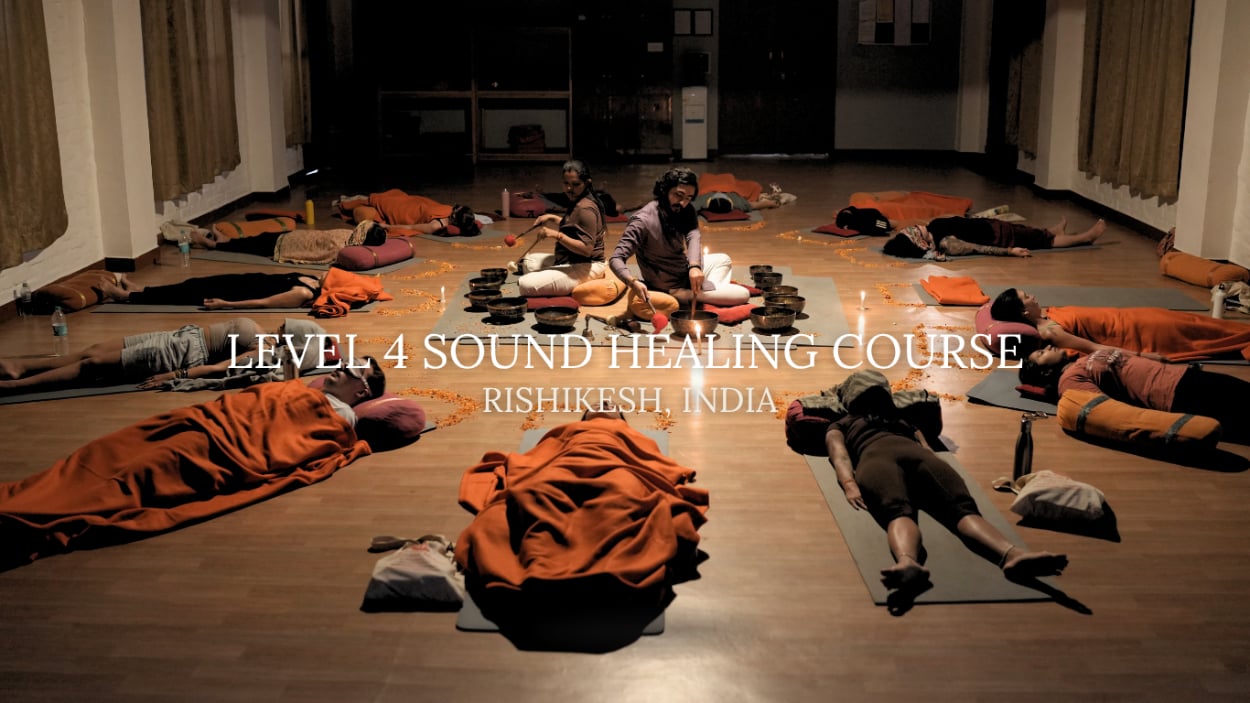
Yoga Nidra in Rishikesh
Rishikesh has long been associated with yoga, meditation, ashram life and the study of Indian philosophy.
Learning Yoga Nidra here can therefore provide something that an audio recording alone cannot: the opportunity to experience the practice in the broader context of yoga.
At Himalayan Yoga Association, meditation and relaxation practices form part of the wider study of yoga alongside asana, pranayama, philosophy, anatomy and teaching methodology.
Students studying a 200 Hour Yoga Teacher Training in Rishikesh can therefore understand relaxation not as an isolated wellness technique, but as one element within a larger yogic discipline.
Students wanting a broader overview of training options can also explore our Yoga Teacher Training Courses in Rishikesh.
Do not put seven commercial links one after another like the current article does.
Our Experience With Yoga Nidra
The original version of this article was published in March 2018 by Himanshu Joshi and developed from practical Yoga Nidra guidance at Himalayan Yoga Association.
Over time, our understanding of how Yoga Nidra should be explained to students has also become more precise.
One of the most important distinctions we teach is simple:
being motionless is not necessarily Yoga Nidra, and being physically relaxed is not the entire practice.
The body becomes quiet so that awareness can become more subtle.
A teacher’s voice can guide the process, but ultimately the practitioner has to experience that movement from external activity toward inner observation.
This is why Yoga Nidra cannot be completely understood simply by reading about it.
The explanation prepares you.
The practice teaches you.
Yoga Nidra FAQ
What is Yog Nidra?
Yog Nidra is another common spelling or search form of Yoga Nidra, a guided yogic relaxation practice commonly performed while lying in Shavasana. The body rests while the practitioner attempts to maintain awareness.
What is the meaning of Yoga Nidra?
Yoga Nidra is commonly translated from Sanskrit as “yogic sleep.” In practice it refers to a state or method of deep rest in which awareness is intentionally maintained.
Is Yoga Nidra just sleeping?
No. Falling asleep can happen, particularly for beginners, but Yoga Nidra traditionally involves maintaining a degree of awareness while the body becomes deeply relaxed.
Is Yoga Nidra the same as Shavasana?
No. Shavasana is a physical posture; Yoga Nidra is a systematic practice that is commonly performed in Shavasana.
Is Yoga Nidra meditation?
Yoga Nidra is often categorized as a guided meditative or relaxation practice, although its method differs from many seated meditation techniques.
How long should a beginner practice Yoga Nidra?
Around 10–20 minutes is a practical starting point. Sessions can gradually increase to approximately 20–30 minutes or longer.
Can I practise Yoga Nidra every day?
Many practitioners include it regularly or daily. The appropriate frequency depends on your routine, training and individual circumstances.
Can Yoga Nidra help with sleep?
Research suggests Yoga Nidra may help some people with sleep-related outcomes, but current scientific evidence is still limited and should not be interpreted as proof that it cures insomnia.
Should I practice Yoga Nidra before bed?
You can. Evening practice is popular because the body is already moving toward rest. If your goal is learning Yoga Nidra itself rather than simply falling asleep, you may also experiment with practising earlier in the day.
What is Sankalpa in Yoga Nidra?
Sankalpa is a concise inner resolve or intention used in several Yoga Nidra traditions. It is generally mentally repeated at selected points during the practice.
Do I need a yoga teacher for Yoga Nidra?
Beginners often benefit from guided instruction because they can follow the practice without worrying about remembering its stages. With sufficient experience, some practitioners develop a personal practice.
What should I wear for Yoga Nidra?
Wear loose, comfortable clothing that does not restrict breathing or create pressure when lying down.
Yoga Nidra: Practice Rather Than Theory
Yoga Nidra appears simple from the outside.
The practitioner lies down.
The eyes close.
The body stops moving.
But the real practice is happening internally.
Awareness moves from external activity toward the body, from the body toward breathing, from breathing toward subtler mental experience, and eventually back outward again.
That is why Yoga Nidra should not be reduced to “sleeping in Shavasana.”
It is a systematic practice of conscious relaxation, inward observation and stillness.
Whether you are encountering Yog Nidra for the first time or returning after years of yoga practice, begin without trying to achieve anything extraordinary.
Lie down.
Become still.
Observe.
Listen.
Remain aware.
And allow the practice itself to reveal its depth.
Om Shanti, Shanti, Shanti.
References & further reading
For the bottom of the article, I would add a genuine “References & Further Reading” section. These are much stronger than linking to generic wellness sites.
Bihar School of Yoga — Yoga Nidra / teachings of Swami Satyananda Saraswati. The school’s own material explains Yoga Nidra as conscious/dynamic sleep and describes its systematic development from tantric nyasa.
Parker S, Bharati SV, Fernandez M. The Origin and Clinical Relevance of Yoga Nidra. This review discusses Yoga Nidra’s historical development, Shavasana relationship and modern practice.
Singh S et al. Effect of Yoga Nidra in Sleep Disturbances and Insomnia: Systematic Review and Meta-analysis, 2026. Particularly useful because it gives you current evidence while explicitly acknowledging the low certainty of existing studies.
Datta K et al. Improved sleep, cognitive processing and enhanced learning and memory task accuracy with Yoga Nidra practice in novices. PLOS ONE, 2023.
Morarji Desai National Institute of Yoga / Ministry of AYUSH. Government yoga guidance includes Yoga Nidra and describes its role as a systematic relaxation practice.